A good sensitive skin laundry routine comes down to five habits: use a fragrance-free, dye-free detergent in the recommended amount, skip scented softeners and dryer sheets, give clothes enough water to rinse, wash new items before wearing them, and keep the washer itself clean. None of it needs special equipment. It needs consistency, and a little attention to what stays behind on fabric after the cycle ends.
Below is the full routine, with the reasoning behind each step, a simple way to test a new detergent, and what to do when you would rather hand the whole thing off.
TL;DR
- Choose a hypoallergenic, fragrance-free and dye-free detergent, and measure it. More soap does not mean cleaner, and leftover residue can irritate.
- Skip scented fabric softener and dryer sheets. If you use any, make them fragrance- and dye-free.
- Wash new clothes before wearing them, don’t overfill the machine, and add an extra rinse when your skin is reactive.
- Keep the washer clean with a monthly hot empty cycle, and wash bedding every 2 to 3 weeks at 140°F (60°C) or hotter where the care label allows.
- If symptoms continue despite these changes, see a doctor.
Table of Contents
- Why laundry can trigger sensitive skin
- Step 1: Pick the right detergent
- Step 2: Measure, don’t eyeball
- Step 3: Skip the scented extras
- Step 4: Set up the wash for a thorough rinse
- Step 5: Dry with care
- Step 6: Handle new clothes and tags
- Step 7: Keep the washer itself clean
- A weekly routine you can actually keep
- Our perspective on sensitive skin laundry
- When to let a professional do the washing
- Skin-friendly laundry, picked up at your door
- When to see a doctor
- FAQ
- Sources
Why laundry can trigger sensitive skin
Clothes, sheets and towels sit against your skin for hours. Whatever the wash leaves in the fibers goes along with them. The usual suspects are fragrances, dyes, preservatives and some cleaning agents (surfactants). Cleveland Clinic lists fragrances, dyes, preservatives such as parabens and formaldehyde-releasers, and some surfactants as ingredients that may cause reactions.
Preservatives deserve a mention. Dr. Chelsey Straight told Women’s Health that isothiazolinone preservatives have a history of causing allergic contact dermatitis and are among the common culprits in detergent-related contact dermatitis. That is one reason a label reading “free and clear” is only a starting point, and why testing a product on your own skin is worth the extra day.
The second source of trouble is not the product but the process: too much detergent, a crowded drum that rinses poorly, or a machine with its own buildup. Fixing those costs nothing.
Step 1: Pick the right detergent
Start with the label. The American Academy of Dermatology advises people with eczema-prone skin to use detergent made for sensitive skin. In practice that means:
- Hypoallergenic, fragrance-free and/or dye-free. This is the core filter, per Cleveland Clinic.
- “Free and clear” formulas. Consumer Reports says these are generally free of dyes, perfumes, optical brighteners, phosphates, phthalates and 1,4-dioxane.
- Fewer extras. Consumer group CHOICE in Australia suggests avoiding enzymes and optical brighteners where possible if your skin is sensitive. Not everyone reacts to enzymes, so treat this as a thing to try if other changes have not been enough.
Liquid or powder?
The National Eczema Association recommends liquid rather than powder detergent. Liquid dissolves more easily in cool and warm cycles, which helps prevent undissolved grains from lingering in fabric.
A note on pods
Pods are convenient, but Consumer Reports advises against them in households with children younger than 6 or cognitively impaired adults, because of exposure risks that include ingestion, inhalation, eye contact and skin absorption. If you share your home with a toddler, a measured liquid is the safer format.
How to patch test a detergent
Before you wash a full wardrobe in something new, run this test, described by Cleveland Clinic:
- Dilute the detergent about 1:1 with water.
- Dab a small amount on your inner arm or wrist.
- Cover it with a bandage for 24 to 48 hours.
- Remove the bandage and check for redness, itching or bumps.
If the spot reacts, rule that detergent out. If you have a history of severe reactions, ask your dermatologist before testing anything on your skin.
Step 2: Measure, don’t eyeball
Use only the recommended amount of detergent, per the AAD. Dermatologist Dr. Zeichner explained to HuffPost that overdosing can leave cleansing molecules between garment fibers, where they may irritate skin.
A few habits make dosing easier:
- Use the cap or scoop that came with the product and fill to the line for your load size.
- Don’t add a second dose because a load is “extra dirty.” Run a longer cycle or pre-treat the stain instead.
- If your water is soft, you may need less. The bottle’s chart usually accounts for this.
Step 3: Skip the scented extras
Scented fabric softener and dryer sheets may contribute to irritation, according to the AAD. These products work by leaving a coating on fabric, which is exactly the opposite of what reactive skin wants.
If you like a softer feel, HuffPost notes that a fragrance-free softener can help with sensitive skin, and that any fabric conditioner or dryer sheet should also be fragrance- and dye-free.
Keeping laundry fresh without fragrance
You do not need scent to get a fresh result. Choose a fragrance-free, dye-free detergent and consider a double rinse to remove residue, as Cleveland Clinic suggests. Cleveland Clinic’s Dr. Khetarpal has pointed out that even people without a diagnosed skin condition may not want fragrance sitting against their skin all day or night. Clothes that smell of nothing are usually clothes that are actually clean.
Step 4: Set up the wash for a thorough rinse
Rinsing matters as much as washing. Two simple changes help most.
Don’t overfill the drum. Healthline advises avoiding overfilling the machine so water can rinse clothes more effectively. Clothes should move freely. If you can’t fit a hand flat on top of the load, take something out.
Add an extra rinse. Eczema Outreach Support’s Washday Wisdom guide says an extra rinse cycle can reduce the amount of chemicals left on clothes and in the machine. Many machines have a dedicated setting. If yours does not, run the rinse-and-spin cycle a second time.
Temperature
Bedding is the item to treat most seriously, since it touches your skin for hours every night. Healthline’s guidance is to wash bedding at 140°F (60°C) or hotter every 2 to 3 weeks. Always check the care label first, since not every fabric tolerates that heat. For everyday clothes, follow the label, and use the detergent amount for the load rather than extra product to compensate for cooler water.
Step 5: Dry with care
Dry freshly washed clothes indoors, in a dryer or on a rack, rather than outside. Healthline says this helps keep seasonal allergens such as grass pollen off your clothes. In a New York apartment, that is rarely a hardship: a folding rack near a window or a dryer cycle without sheets does the job.
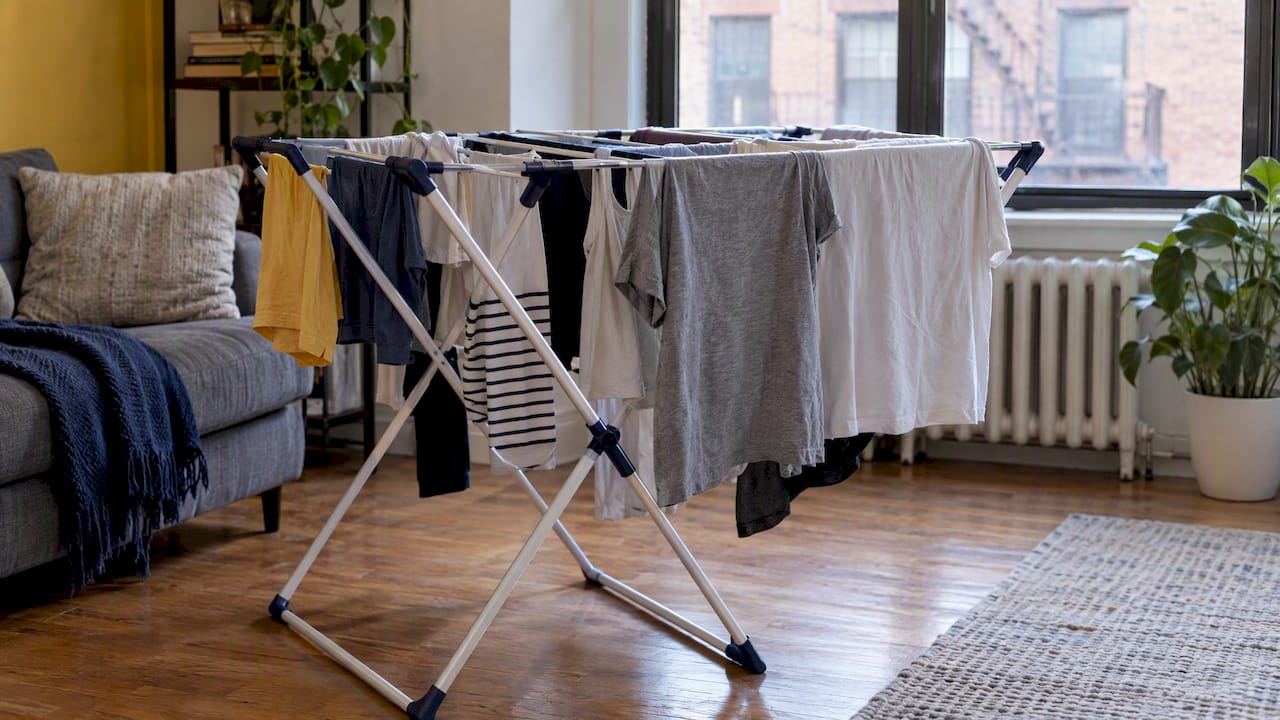
When using a dryer, skip scented sheets and clean the lint trap every load. Pull clothes out promptly and fold them while they are still slightly warm to limit wrinkles and the musty smell that can develop in a damp drum.
Step 6: Handle new clothes and tags
Wash new clothes before wearing them. The AAD says this removes excess dyes and fabric finishers that can irritate skin. This includes bedding, towels and baby clothes. A newly bought white T-shirt can carry finishing chemicals that you never see.
The AAD also recommends buying clothes without tags, since tags can rub against the skin. Cut them out carefully, or choose tagless labels when you shop.
Step 7: Keep the washer itself clean
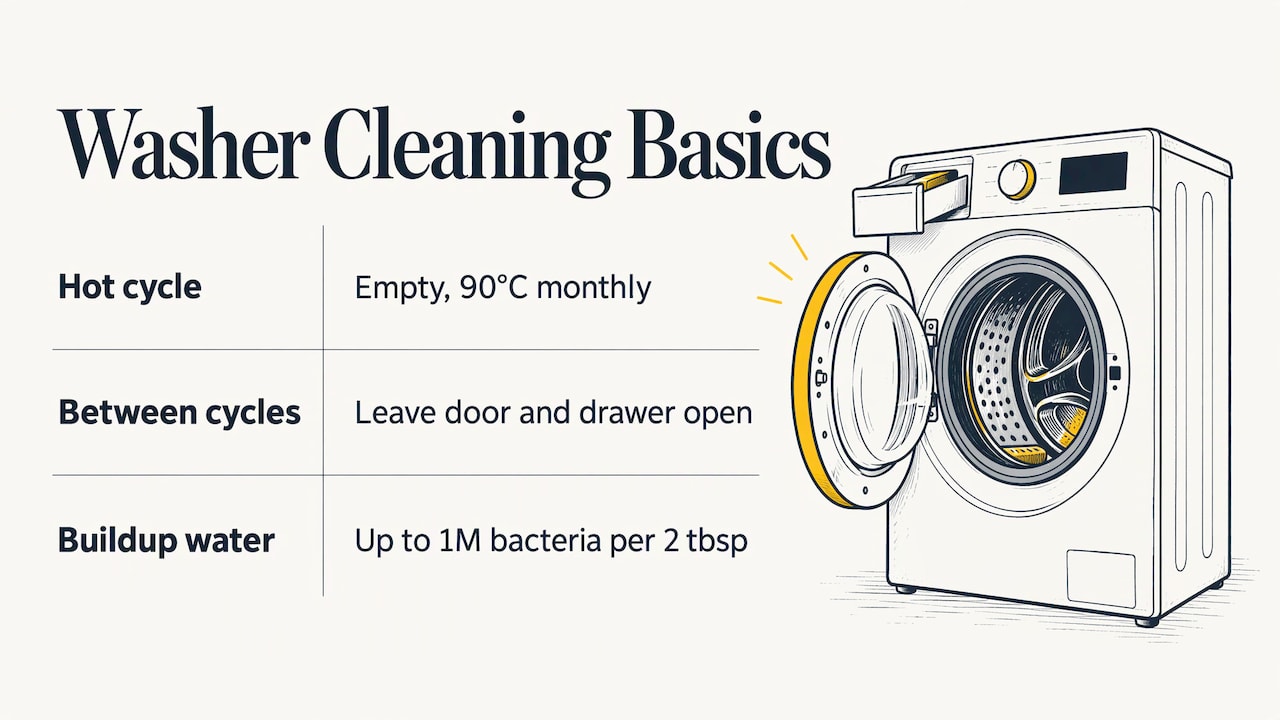
A dirty machine can undo a careful routine. The Washday Wisdom guide recommends running a hot empty cycle at 90°C (194°F) monthly, and leaving the door and detergent drawer open between cycles so the machine can dry out. It also reports that studies have found as many as one million bacteria in two tablespoons of wash water from a machine with buildup.
If your machine already has a stale odor, this guide to fixing a smelly washing machine walks through cleaning the drum, gasket and drawer. Shared building machines are harder to control, which is one more reason some New Yorkers send laundry out.
A weekly routine you can actually keep
| Task | How often | What to do |
|---|---|---|
| New clothes and linens | Before first wear | Wash once with your sensitive-skin detergent |
| Everyday clothes | As needed | Measured liquid detergent, no softener or scented sheets, extra rinse if skin is reactive |
| Bedding | Every 2 to 3 weeks | Hottest temperature the label allows, up to 140°F (60°C) or higher |
| Washer cleaning | Monthly | Hot empty cycle, then leave door and drawer open |
| After every load | Always | Dry indoors, empty the lint trap, leave the door ajar |
Our perspective on sensitive skin laundry
At 5 Boro Laundry, we have more than 20 years of experience handling New York laundry, and the most common thing we see is how much of a skin-friendly routine depends on consistency. One careful load is easy. Doing it every week, with a measured dose, a proper rinse and no scented extras, is where most households struggle, especially in a small apartment with a shared machine or a trip to a basement laundry room.
That is why our service is built around premium and hypoallergenic detergents, handled by our own in-house staff for pickup and delivery, rather than a rotating cast of strangers. We designed our flat-rate laundry bag so you can pack as much as you like without worrying about weight, and our pricing is transparent, with no pickup or delivery fees.
Our view is simple: if your skin reacts to laundry, the best routine is the one you can repeat without effort. Handing the washing to a team that uses gentle products every time takes the guesswork out of it, and gives you back your Sunday.
the author
When to let a professional do the washing
Some people want to run this routine at home. Others have a building machine that is shared, a toddler with eczema, or a schedule that leaves no room for monthly hot cycles and double rinses. For them, a pickup and delivery service is a practical option.
What to look for in a service if you have sensitive skin:
- Detergent choice. Ask what products are used, and whether they are hypoallergenic and free of fragrance.
- Consistency. The same team and process each time is easier to trust than a different one each week.
- Special instructions. You should be able to say “no softener, no scented sheets” and have it followed.
- Clear pricing. A flat rate prevents surprises when bedding and towels make the bag heavy.
Our hypoallergenic laundry service for sensitive skin page explains how we approach this, and how premium, skin-safe laundry care changes everyday clothing.
Sorting matters too: separating towels, bedding and everyday clothes prevents lint transfer and lets you wash each at the right temperature. We cover it in how to sort laundry properly.
Skin-friendly laundry, picked up at your door
If you live in Manhattan, Brooklyn or Queens and want the routine done for you, we pick up, wash and fold, and deliver. You pack a flat-rate laundry bag with no weight limit, and same-day service options are available. We use premium, hypoallergenic detergents, and there are no pickup or delivery fees.

For regular laundry, our subscription plans start at $69 per month for Bronze, $89 per month for Silver and $109 per month for Gold. See the details on the laundry subscription packages page, or start with wash and fold for a single order. Not sure how it works? From pickup to return explains each step.
When to see a doctor
Changing your laundry habits helps many people, but not all. If the steps above do not help, contact a doctor about your symptoms, as Medical News Today advises. Book sooner if you have widespread rashes, broken or weeping skin, or reactions that return after you have removed likely triggers. A dermatologist can run proper patch testing and tell you which ingredients to avoid.
FAQ
What is the best laundry routine for sensitive skin?
Use a hypoallergenic, fragrance-free, dye-free liquid detergent in the recommended amount, add an extra rinse, avoid scented softener and dryer sheets, and dry indoors. Wash new clothes before wearing them and keep your washer clean with a monthly hot cycle.
Is liquid or powder detergent better for sensitive skin?
The National Eczema Association recommends liquid over powder. Liquid tends to dissolve more completely, so less undissolved product is left in fabric. Whichever form you pick, measure it and choose a fragrance-free, dye-free formula.
Should I use fabric softener if I have sensitive skin?
Scented softeners and dryer sheets may contribute to irritation, so most people with reactive skin are better off leaving them out. If you want softness, a fragrance-free and dye-free product is the option dermatologists point to.
How do I make laundry smell fresh without irritating my skin?
Wash with a fragrance-free detergent, avoid overloading the machine, and use an extra rinse to remove residue. Keep the washer clean and dry clothes promptly, since damp drums cause most musty smells.
Sources
- Atopic dermatitis: Self-care, American Academy of Dermatology
- How To Tell if You’re Allergic to Laundry Detergent, Cleveland Clinic
- Best Laundry Detergent Buying Guide, Consumer Reports
- How to buy a great laundry detergent, CHOICE
- Can laundry detergent cause eczema?, Medical News Today
- The 6 Best Laundry Detergents, Women’s Health
- The Best Laundry Routine For Sensitive Skin, HuffPost
- Laundry Routine for Skin Health, Healthline
- Washday Wisdom, Eczema Outreach Support
- Should you wash new clothes before wearing them, Cleveland Clinic Newsroom