A commercial laundry process is a controlled sequence: items are received and counted, sorted by color, fabric and soil level, pre-treated, washed in industrial machines, dried, finished (pressed or folded), checked and returned. Each stage exists to protect the fabric and make results repeatable at volume. Below is how that sequence works, what equipment does each job, how long it takes, and how it differs from dry cleaning.
TL;DR
- A commercial process runs in order: intake and tagging, sorting, pre-treatment, washing, extraction, drying, finishing, quality check, return.
- Sorting by color, fabric type and soil load is what lets each load get the right wash formula and keeps dyes from transferring.
- Washing uses water, detergent and mechanical action. Dry cleaning uses non-water solvents. Professional wet cleaning is a water-based option for many “dry clean” garments.
- Total time depends on load size, soil level, fabric and finishing. Machine cycles are usually under two hours, while turnaround for a customer is set by the provider’s schedule.
- For homes and businesses in New York City, we run this process for you with pickup and delivery, so you never touch a machine.
Table of Contents
- What “commercial laundry” actually means
- The commercial laundry process, step by step
- Process at a glance
- What equipment does the work
- How long does a commercial load take?
- Commercial laundry vs. dry cleaning vs. wet cleaning
- How the process changes by industry
- How to judge a commercial laundry provider
- Our perspective
- Let us run the process for you
- FAQ
- Sources
What “commercial laundry” actually means
Commercial laundry is laundering done at scale and to a standard: hotel sheets, restaurant linens, gym towels, uniforms, medical linens, and household wash & fold for people who would rather not do it themselves. The difference from home laundry is not just bigger machines. It is process control. Staff track every item from the moment it arrives, choose wash formulas by load type, and check the work before it goes back out.
The cleaning science is the same one your kitchen machine uses. An institutional laundry guide describes four balanced factors: time, temperature, mechanical action and chemical concentration, with water as the solvent in a water-washing system. Change one factor and you adjust another. A cooler wash, for example, may need longer time or stronger chemistry. Commercial operations set these on purpose for each load type instead of guessing.
The commercial laundry process, step by step
Facilities differ in layout, but the flow is remarkably consistent. A military example shows it clearly: at the West Point laundry, items are inventoried, tagged and hand-sorted on receipt, then washed or dry-cleaned, dried, sorted, pressed or folded and rechecked for quality, with a stated 48-hour return. Here is the same arc broken into stages.
1. Pickup, intake and tagging
Everything starts with knowing what came in. Bags or bins are opened, items are counted or weighed depending on the service, and each order is tagged so it stays together through every machine. This is where lost socks and mixed-up orders are prevented. Special instructions (a stain you flagged, a fabric that needs low heat) are attached to the order here, not discovered later.
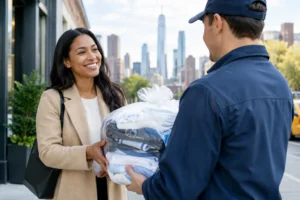
For our customers in Manhattan, Brooklyn and Queens, this stage begins at your door. Our pickup and delivery is handled by dedicated in-house staff, and we charge no pickup or delivery fees. You can read more about how professional laundry delivery works in NYC.
2. Sorting
Sorting is the most underrated step. Commercial items are sorted by color, fabric type and soil load, commonly grouped as light, medium and heavy, so compatible materials share a wash formula and colors do not bleed. A load of lightly worn white shirts and a load of greasy kitchen aprons should never share a cycle.
Typical sorting categories:
- Whites and lights: dress shirts, sheets, white towels
- Colors and darks: separated to control dye transfer
- Heavily soiled: work uniforms, bar towels, gym towels
- Delicates: items needing gentler mechanical action and lower temperatures
- Dry-clean-only or special care: routed to a different process entirely
If you want the home version of the same logic, see our guide on properly sorting laundry.
3. Pre-treatment and spotting
Stains are handled before the main wash, because a normal cycle will not always remove them. The two standard methods are prespotting, where chemicals are applied to a wetted stained area and the item is washed promptly, and presoaking the whole item in a presoak solution. Contact times in that guide range from about 15 minutes to overnight, depending on the stain and fabric.
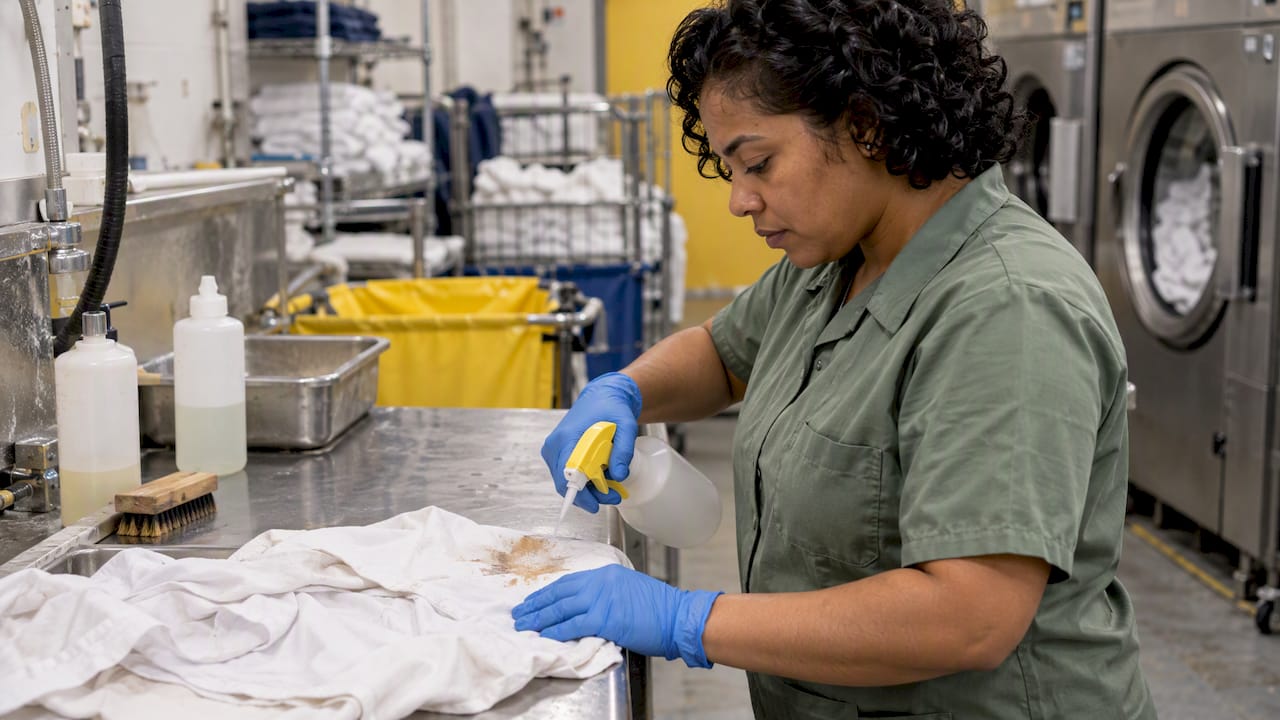
The practical lesson: do not dry a stained item. Heat sets many stains. If you are sending laundry out, flag stains on the order so the right treatment is used before the wash.
4. Loading and washing
Operators load machines by sorted category and by capacity, because overloading reduces mechanical action and underloading wastes water and energy. Each machine runs a programmed formula: water level, temperature, detergent and additive injection, and cycle length.
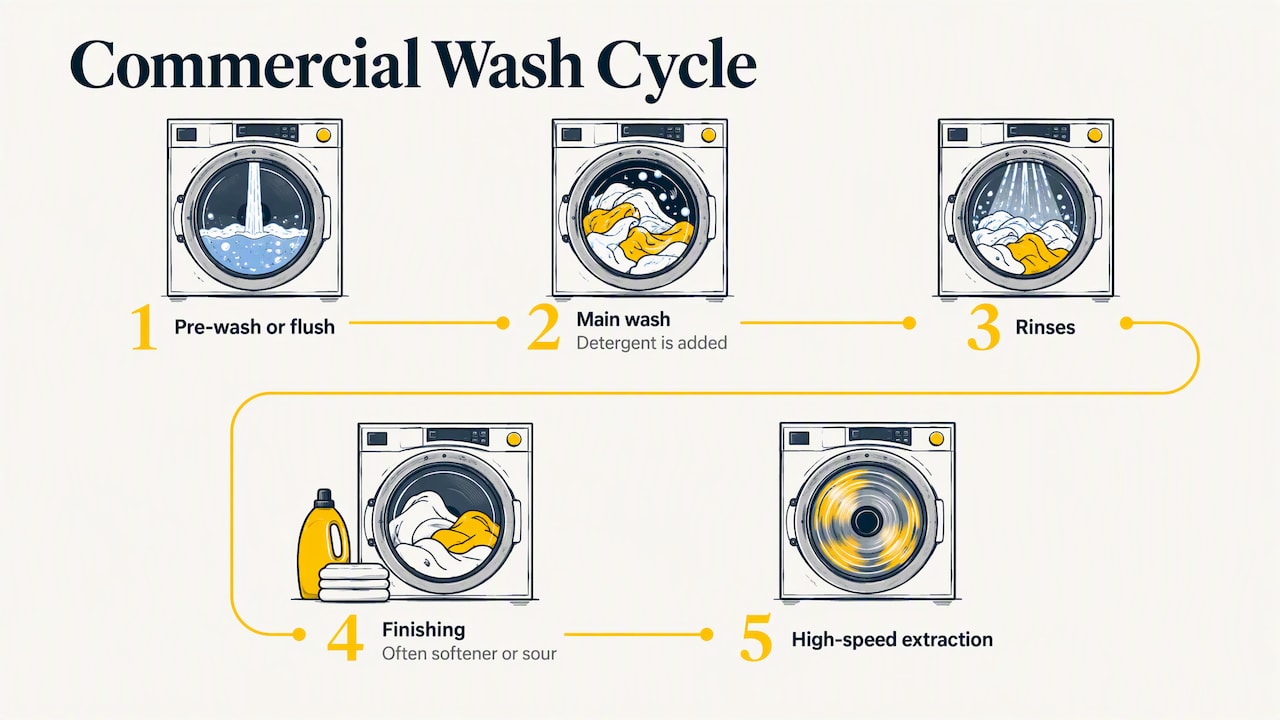
A water-based cycle consists of repeated water fills, washing and draining, ending with a high-speed extraction. Typical formula stages are a pre-wash or flush, the main wash with detergent, rinses, and often a finishing step such as a softener or sour for pH balance.
Temperature depends on the item and the risk. For healthcare linens, CDC guidance for global healthcare settings calls for hot water at 70 to 80 °C (158 to 176 °F) for 10 minutes with an approved detergent, and notes the effectiveness of laundering depends on time and temperature, mechanical action, water quality, load volume and soil level. Everyday household and restaurant linens follow the fabric’s care needs instead.
Detergent choice matters for people. All of our services use premium and hypoallergenic detergents, which is designed to suit households with sensitive skin.
5. Extraction
After the final rinse, the machine spins at high speed to remove most of the water. In washer-extractors, high-speed centrifugal force removes water, and capacities in U.S. facilities range from 30 to 800 pounds per load. Good extraction shortens drying, which saves time and energy and is gentler on fabric than long heat exposure.
6. Drying
Items go to tumble dryers, again grouped by fabric. Cotton towels tolerate high heat; synthetics, elastic and many uniforms do not. Over-drying is a quiet cause of shrinkage, stiffness and wear, so dryers are set by fabric class and monitored by the operator.
7. Finishing: pressing, folding and packing
After drying, items are inspected and finished. Shirts and linens may be pressed, towels and everyday clothes folded, and uniforms hung or bagged. West Point’s process includes sorting after drying and a quality recheck before return, which is the same logic any good provider applies: count the order, check for missed stains, and rewash anything that is not right.
For a look at what this looks like for household orders, read what really happens at a wash & fold facility.
8. Quality check, storage and return
The last step is verification and handoff. The order is matched against its intake tag, packed, and either stored or delivered. On a commercial contract this also means scheduled routes: clean linens in, soiled linens out, on a rhythm that matches the business.
Process at a glance
| Stage | What happens | Why it matters |
|---|---|---|
| Intake and tagging | Items counted, tagged, instructions noted | Prevents lost or mixed items |
| Sorting | Grouped by color, fabric, soil load | Protects colors and fabric, matches the formula |
| Pre-treatment | Prespotting or presoaking | Lifts stains a normal cycle may miss |
| Washing | Programmed formula of water, heat, detergent, action | Cleans consistently |
| Extraction | High-speed spin removes water | Shortens drying, reduces fabric stress |
| Drying | Tumble dried by fabric class | Avoids shrinkage and over-drying |
| Finishing | Pressed, folded, hung | Ready-to-use result |
| Quality check | Recount, inspect, rewash if needed | Catches problems before delivery |
What equipment does the work
You do not need to know every machine, but these are the main ones:
- Washer-extractors: wash and spin in one machine. They are used in many U.S. facilities and, per EPA materials, range from 30 to 800 pounds per load.
- Tumble dryers: industrial dryers sized to match washer loads.
- Presses and finishing equipment: for shirts, flat linens and uniforms.
- Chemical dosing systems: inject detergent and additives at the right stage so concentration is consistent.
- Sorting, tagging and conveyor or cart systems: keep each order identifiable.
Large hotel and hospital plants add continuous-batch systems and flatwork ironers. A neighborhood-scale or city service relies mostly on washer-extractors and dryers with careful hand sorting and finishing, which is also where individual garment care happens.
How long does a commercial load take?
The honest answer has two parts: machine time and turnaround time.
Machine time. One equipment manufacturer publishes typical figures of 35 to 65 minutes for a wash and 25 to 40 minutes for drying, with quick cycles for lightly soiled linens at the short end. Those are one brand’s numbers, and your results depend on the factors below, but they show why a commercial load is usually done in about one to two hours of machine time, plus sorting and finishing.
Turnaround time. This is what you feel. It is set by the provider’s schedule: when pickup happens, how many orders are ahead of yours, and whether finishing is simple (fold) or labor-heavy (press, hang, spot). A facility like West Point’s states a 48-hour return. We offer same-day turnaround options for NYC orders, so ask when you book what is available for your address and pickup time.
What changes total time:
- Load size and volume. Bigger orders take more machine cycles.
- Soil level. Heavily soiled items need longer pre-treatment and sometimes a second wash.
- Fabric. Delicates run gentler, often longer, and dry at lower heat.
- Finishing. Pressing, hanging and special packing add handling time.
- Route and schedule. Delivery windows can matter more than machine minutes.
Commercial laundry vs. dry cleaning vs. wet cleaning
People often assume dry cleaning is just a premium version of washing. It is a different process.
Water-washing uses water, detergent, heat and agitation, then extraction and drying, as described above.
Dry cleaning uses solvents instead of water. The EPA’s dry-cleaning profile defines it as cleaning fabrics with nonaqueous organic solvents and lists three core steps: solvent washing, spinning to extract excess solvent, and tumbling in hot air to dry. California’s guide adds that “dry” is a misnomer: the solvents are liquids, and the word only separates solvent cleaning from water-based cleaning.
Professional wet cleaning is a third route. The same guide describes it as a scalable, water-based commercial process for delicate textiles, including garments labeled “Dry Clean” or “Dry Clean Only”. It uses specially designed washers, detergents and additives, controlled drying and restorative finishing.
| Wash & fold | Dry cleaning | Wet cleaning | |
|---|---|---|---|
| Cleaning medium | Water and detergent | Non-water solvent | Water with specialized detergents |
| Best for | Everyday clothes, bedding, towels | Structured or delicate garments labeled for it | Delicate items, including some labeled dry clean |
| Finishing | Folded | Pressed, hung | Pressed, restorative finishing |
Not sure which service fits an item? Our comparison of wash & fold versus dry cleaning walks through it, and you can see what happens to clothes during professional dry cleaning.
How the process changes by industry
The skeleton stays the same, but the details shift with the risk and the fabric.
- Hotels: high volumes of sheets, towels and robes on tight daily cycles, with infection control in mind. Predictable routes and par levels (how much linen the property keeps in circulation) matter as much as washing.
- Healthcare: strict handling of soiled linen, designated laundering areas and defined hot-water or disinfection parameters, as in the CDC guidance above.
- Gyms, spas and salons: towels in volume, where freshness and sanitation are part of the customer experience. See why clean, sanitized towels matter.
- Restaurants: heavy grease and food soil, so pre-treatment and detergent selection do much of the work.
- Uniform programs: consistent appearance, repairs and replacement, and scheduled returns. Our commercial uniform laundry service page explains how that works in NYC.
A broader look at who relies on this is in industries that depend on specialized laundry.
How to judge a commercial laundry provider
Whether you are a household or a business, ask the same questions:
- How are items tracked? Tagging at intake is the baseline.
- How are loads sorted? Color, fabric and soil, not just “lights and darks.”
- What detergents are used? Ask if they are hypoallergenic or suited to sensitive skin if that matters to you.
- Is there a quality check before return? And what happens if something is missed?
- Is pricing clear? Look for flat or published rates, and ask about pickup, delivery and any other fees.
- What are the turnaround options? Standard, rush and same-day should be spelled out.
- Who handles pickup and delivery? In-house staff are easier to hold accountable than a chain of subcontractors.
Our perspective
We have spent over 20 years watching what separates a good laundry result from a disappointing one, and it is almost never the machine. It is the handling before and after the machine: tagging, sorting, stain attention, a second look at the finished order.
That is why we built our service around predictability. Our flat-rate laundry bag lets you pack as much as you want without worrying about weight limits, our pricing is transparent with no pickup or delivery fees, and our own staff handle your order from pickup to return. Premium, hypoallergenic detergents are part of every service, because clothes touch skin all day.
For businesses, we apply the same discipline at volume: towels, uniforms, medical and hotel linens on a schedule you can plan around. When the process is done right, you stop thinking about laundry at all, and that is the whole point.
the author
Let us run the process for you
If you would rather skip the sorting, spotting and folding, we do it all with pickup and delivery across NYC. For households, wash & fold uses our flat-rate bag. If laundry is a weekly habit, our subscription packages are Bronze at $69 per month, Silver at $89 per month and Gold at $109 per month.
Businesses can set up recurring service for towels, uniforms, medical linens and hotel linens through our commercial laundry services. Pricing for commercial work is not published, so request details for your volume.
FAQ
How long does a commercial load of laundry take?
Machine time is typically about an hour or two. One manufacturer cites 35 to 65 minutes for washing and 25 to 40 for drying. Your turnaround depends on the provider’s schedule, soil level and finishing. We offer same-day options in NYC, so confirm availability when you book.
What is professional wet cleaning?
It is a commercial water-based process for delicate textiles, including some garments labeled dry clean only. California’s guide says it uses specialized washers, detergents and additives, controlled drying and restorative finishing. It differs from dry cleaning because it uses water rather than a non-water solvent.
What equipment is used in a commercial laundry?
The core machines are washer-extractors, tumble dryers and finishing equipment such as presses, supported by chemical dosing and tagging systems. Washer-extractors use high-speed centrifugal force to remove water. Larger plants add continuous systems and flatwork ironers.
How is commercial laundry different from dry cleaning?
Commercial laundry washes with water, detergent and mechanical action. Dry cleaning uses non-water organic solvents in a wash, spin and hot-air drying sequence. Which one an item gets depends on its fabric and care label.
Sources
- Understanding the Institutional Laundry Environment
- Laundry facility keeping things clean at West Point since 1954
- EPA AP-42, Vol. I, Ch. 4.1: Dry Cleaning
- California Air Resources Board: Wet Cleaning Guide
- EPA WaterSense at Work: Sanitary Fixtures and Equipment
- CDC: Appendix D, Linen and laundry management
- Commercial laundry cycle times
Recommended
- From Pickup to Return: How Professional Laundry Delivery Services Work in NYC
- Inside the Fold – What Really Happens at a Wash & Fold Facility
- How Commercial Laundry Services Help Businesses Manage Large Volumes of Linens
- How Commercial Laundry Services Help NYC Businesses Maintain Professional Standards