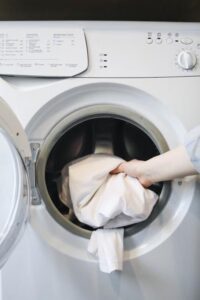
Most mattress pads can be cleaned at home in a washing machine, but only if you match the method to the material on the care label. Cotton and synthetic pads are the easy case. Down, wool and silk need gentler handling or professional care, and foam can never go in the washer. This guide covers how often to wash, what to do for each material, how to spot-clean, and when a pickup-and-delivery service saves you a trip to the laundromat, which matters in a New York apartment with no washer of your own.
TL;DR
- Wash your mattress pad about once a month, or whenever it is stained, and read the care label before every wash.
- Cotton, cotton-blend and synthetic pads usually take a warm, normal machine cycle and a low-heat dry. Skip bleach and fabric softener unless the label allows them.
- Foam toppers are spot-cleaned only. Only a removable cover can go in the machine.
- Bulky, delicate or label-restricted pads (down, wool, silk) are the ones worth handing to a professional.
- A pad has to be completely dry before it goes back on the bed, or moisture can lead to mildew.
Table of Contents
- How often to wash a mattress pad
- Read the care label first
- Cleaning by material
- Spot-cleaning a stain without washing the whole pad
- Drying: where most mattress pad problems start
- The New York problem: where do you wash something this big?
- Our perspective
- Getting it done without the laundromat trip
- Mistakes that shorten a mattress pad’s life
- Storing a topper between seasons
- FAQ
- Sources
How often to wash a mattress pad
The most common advice is monthly. Forbes’ bedding guide recommends washing mattress pads and covers every month, alongside the rest of your bed layers. That is a good default if you sleep on the bed every night, share it with a partner, or have a pet that climbs up.
Some households stretch the interval. If the pad sits under a fitted sheet and a separate protector, every two to three months can work, as long as you wash it right away after a spill, a night of illness, or a visible stain. A pad that is allergen-sensitive, or that sits on a bed used daily by a child, belongs on the monthly end.
A simple rhythm many people find easy to keep:
- Sheets and pillowcases: weekly.
- Mattress pad or protector: monthly.
- Comforter or duvet: seasonally, and at once after any spill.
- Foam topper: spot-clean as needed, and deep-clean the cover with the pad.
Pick one weekend a month, strip the whole bed, and do the pad while the sheets run. That way it never gets skipped.
Read the care label first
Every guide that ranks for this topic starts in the same place, and for good reason: two pads that look identical can need opposite treatment. Tom’s Guide tells readers to check the manufacturer’s care label before cleaning anything. The label tells you the water temperature, the cycle, whether bleach is allowed and how hot the dryer can run.
The label can differ even between products from the same brand. Sleep Number’s own care instructions call for a warm wash with a cold rinse on a delicate cycle for its Total Protection pad, but a cold, gentle wash for its Climate Total Protection pad. Both need low-heat drying. The first must not be bleached, while the second allows non-chlorine bleach when needed. Likewise, American Textile’s care page separates standard and organic pads (machine-washed warm, tumble-dried low) from a hot-water-washable pad that can take a hot wash, and allows non-chlorine bleach only when the instructions say so.
If the label is missing or has faded, treat the pad as the most delicate version of its material: cool water, gentle cycle, low heat.
Cleaning by material
| Material | Machine wash? | Typical method | Watch out for |
|---|---|---|---|
| Cotton, cotton blend, bamboo, synthetic | Yes | Warm water, normal or gentle cycle, low-heat dry | Bleach and fabric softener, high heat |
| Down or feather fill | Often, per label | Cold, gentle cycle, small amount of detergent, extra rinse | Clumping if not fully dried |
| Wool | Spot-clean or professional | Spot-treat stains, follow the label | Felting and shrinking |
| Silk | Usually professional | Follow the label | Heat, harsh detergent |
| Memory foam or foam | Never in a washer | Spot-clean, air-dry flat | Soaking, agitation, bleach |
| Waterproof or vinyl-backed protector | Yes, usually | Gentle wash, low heat | High heat can damage the backing |
Cotton, cotton-blend and synthetic pads
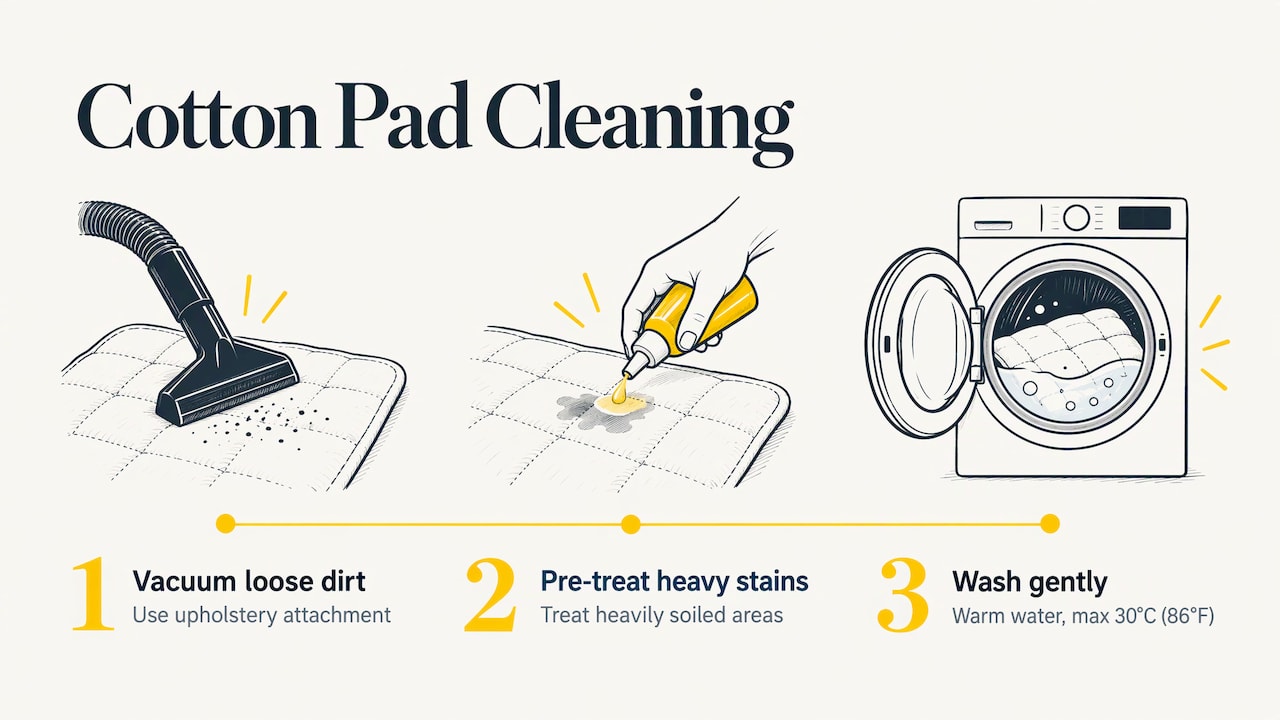
This is the simplest group. Tom’s Guide suggests vacuuming a cotton pad with an upholstery attachment to lift loose dirt, then pre-treating heavily soiled stains, then running a gentle warm wash no hotter than 30°C (about 86°F). Use a front-loader or a top-loader without a central agitator if you can. The agitator in older top-loaders twists and tears thick, quilted pads.
Use a normal amount of mild detergent, skip the fabric softener (it can leave a film that reduces the pad’s softness and its ability to breathe), and avoid chlorine bleach unless the label explicitly permits it.
A pad is bulky. Do not stuff it into a machine that is already half full of sheets. Give it room to move so it rinses clean, and consider an extra rinse if you see suds in the final spin.
Down and feather pads
Tom’s Guide notes that down pads typically use a cold, gentle cycle with only about a quarter of the usual detergent. Excess detergent is the usual culprit when a down pad comes out stiff or clumped, because the fill traps soap. Rinse well, and dry on the lowest heat with a couple of clean dryer balls or tennis balls if the label allows them, to keep the fill from bunching. A down pad that feels dry on top can still hold damp pockets inside, so give it extra drying time.
If the pad is large, if your building’s machines are small, or if the label says dry clean only, this is a job for a professional.
Wool and silk
Wool is the material most likely to be ruined at home. Tom’s Guide advises spot-treating wool stains, because untreated wool can felt or shrink when it gets wet and agitated. Silk-filled and silk-covered pads carry similar warnings. When the label points to professional cleaning, follow it rather than testing a gentle cycle and hoping.
Foam and memory foam
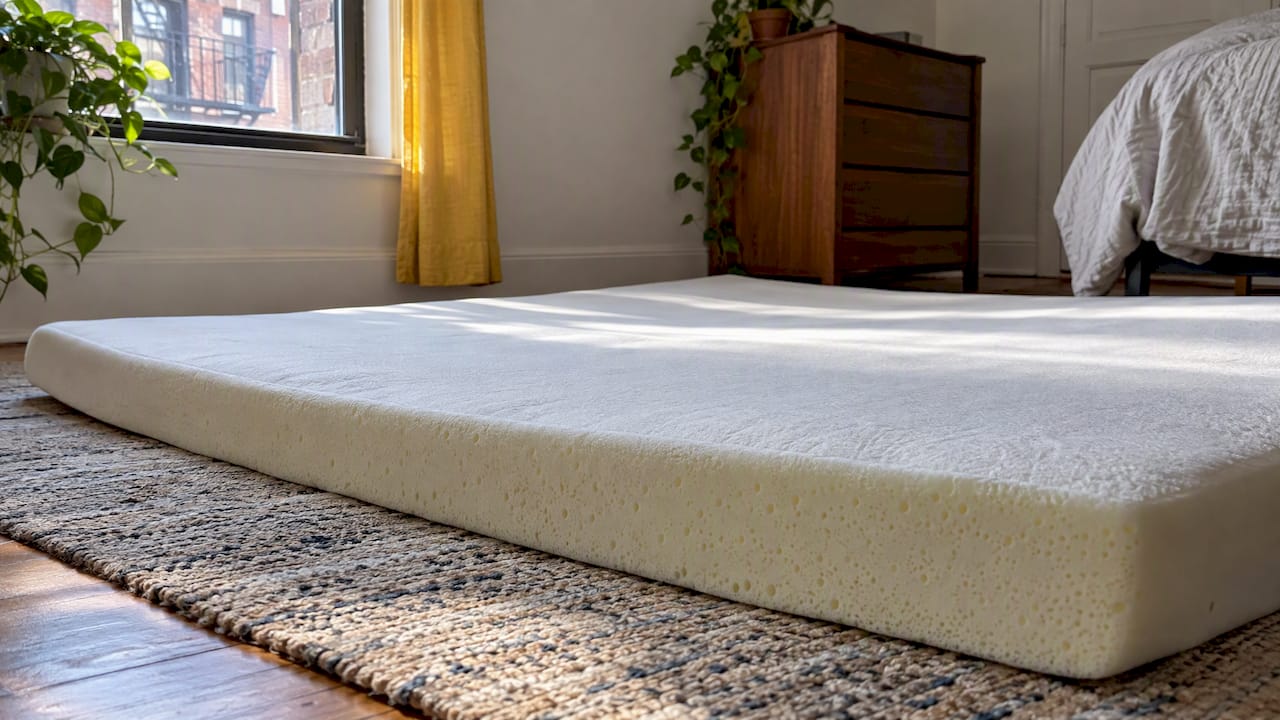
Foam is the rule-breaker. IKEA’s topper guidance says to remove the cover and follow its washing directions, and that the memory foam itself is not machine washable. The Spruce says never to put a foam pad in a washer or dryer, because agitation and spinning can damage it. It recommends gentle spot cleaning, no bleach or harsh chemicals, and air-drying flat until completely dry.
Sleep Number’s instructions follow the same logic: spot-clean the foam layers only, wash a removable cover separately on a gentle cold cycle with mild detergent, and dry it low. Some foam layers call for warm, mild, soapy water without saturating the foam.
Spot-cleaning a stain without washing the whole pad
For foam, and for any pad you do not want to put through a full wash, Tom’s Guide gives a simple method:
- Mix equal parts water and white vinegar. A drop of mild detergent or a little lemon juice is optional.
- Dab the solution on the stain. Do not oversaturate the foam.
- Rinse by dabbing with a clean cloth dipped in cold water.
- Blot away as much moisture as you can with a dry towel.
- Let the foam dry completely before you put the sheets back on.
Dab, never rub. Rubbing pushes the stain deeper into the foam. Work from the outside of the stain toward the center so it does not spread. For fresh spills, blot first, wet second.
The search results for this topic include a home mix of hydrogen peroxide, baking soda and a drop of dish soap. It is a popular tip in forums, but the manufacturers we cited above only describe mild soap or vinegar solutions, so for any branded pad, start with what the care page says.
Drying: where most mattress pad problems start
Washing is the easy part. Drying is where pads get ruined or turn musty. Tumble dry on low, and take the pad out promptly when the cycle ends, as American Textile advises. Check the thick seams and corners by hand. Quilted edges stay damp longest.
Moisture trapped in a pad does not stay in the pad. The Spruce’s mattress protector guide warns to make sure a protector is thoroughly dry before returning it to the mattress, since trapped moisture could cause mildew growth on the mattress. If your dryer cannot finish the job, run a second low-heat cycle rather than turning the heat up. High heat shrinks cotton blends and can damage waterproof backing.
For foam, there is no machine shortcut. Lay it flat in a well-ventilated room and give it time, often a full day. Flip it once so both sides dry.
The New York problem: where do you wash something this big?
In a city where many of us share a basement laundry room or walk to a laundromat, a mattress pad is the item people put off. It fills a whole machine, it needs a second dryer cycle, and it eats an afternoon. That is why pads, comforters and blankets are among the bulky items people pass to a service, and why mattress pad cleaning is a natural fit for pickup and delivery.
The practical questions to settle before you hand anything over:
- What does the label say? Read it out when you book. Machine-washable cotton is simple. Dry clean only needs a dry cleaning route.
- Is there a removable cover? For a foam topper, the cover can be cleaned as laundry. The foam stays with you for spot-cleaning.
- Are there stains? Point out the spot. Tell your provider what caused it, whether coffee, a pet accident or something else, so it gets pre-treated.
- Do you have fragrance or skin sensitivities? Ask which detergents are used.
- When do you need it back? Your bed is bare without it, so ask about turnaround before you schedule.
If you also want fitted sheets, pillowcases and duvet covers done in the same trip, the same pickup can handle the whole bed. For bedding in volume, such as rental units, the idea scales; our piece on laundry services for short-term rental hosts explains how hosts keep turnover fast.
Our perspective
We hear the same thing from New Yorkers again and again: the sheets get washed, the mattress pad does not. It is awkward to carry, it needs a big machine, and it is easy to ruin if you guess at the settings.
Our view is that the care label should decide everything, and that the right person to follow it is someone who handles garments and linens every day. That is how we work. We are an in-house team with more than 20 years of expertise, we use premium, hypoallergenic detergents, and we keep pricing transparent with no pickup or delivery fees.
Our flat-rate laundry bag is built for exactly this kind of bulky load: you pack as much as you want without a weight limit, so a bed’s worth of linens does not turn into a surprise bill. If the label on your pad says professional cleaning, that is where our dry cleaning comes in.
Tell us what your label says when you schedule, and we will take it from there.
the author
Getting it done without the laundromat trip
If you would rather not haul a pad down the stairs, we pick up and deliver across Manhattan, Brooklyn and Queens. Our wash and fold service covers everyday machine-washable bedding, and our professional dry cleaning covers items whose labels call for it. Same-day options are available.
If bedding is a monthly task for you, our laundry subscription packages are priced at $69 (Bronze), $89 (Silver) and $109 (Gold) per month, so the cost stays predictable. You can see what each plan includes on that page.

Want to know how a pickup actually runs, from bag to doorstep? Read how professional laundry delivery works in NYC, or book a pickup from our homepage.
Mistakes that shorten a mattress pad’s life
- Washing foam in a machine. It can tear the foam and leave it lumpy.
- Using too much detergent. Pads are thick, and leftover soap holds dirt and stiffens the fill.
- Using fabric softener. It coats fibers and can cut breathability.
- Setting the dryer to high. It shrinks cotton blends and can damage waterproof backing.
- Putting the pad back damp. It invites mildew on the pad and the mattress under it.
- Ignoring wool. Heat and agitation make it felt and shrink.
- Skipping the label. Different models from the same maker can need different cycles.
A protector or pad exists to take the wear so the mattress does not. Washing it on schedule, with the right settings, is what lets it do that job for years.
Storing a topper between seasons
If you swap toppers or pads for summer, clean and dry the item fully first. Store it flat or loosely rolled in a breathable bag, not sealed airtight plastic, which holds moisture. Keep it away from heat sources and out of damp closets or basement storage. Wool and down also do better with good airflow, so avoid cramming them under heavy boxes.
FAQ
Can you use a carpet cleaner on a mattress?
We would not use one on a pad or foam topper. Foam and thick fill hold water, and a carpet cleaner leaves them wetter than a damp cloth would. Spot-clean with a dabbed vinegar-and-water solution instead, blot dry, and let it air-dry completely.
Can you tumble dry a mattress pad?
Usually yes, if it is cotton, a blend or a synthetic, on the lowest heat setting and removed promptly. Foam must never go in a dryer. Down pads need low heat and extra time, and any pad should be fully dry before it goes back on the bed.
Can you wash a memory foam mattress topper?
Not in a machine. Remove the cover and wash it as its label directs, then spot-clean the foam with a mild solution, blot it and air-dry it flat. Both IKEA and The Spruce give this same guidance.
How do I know whether to wash a pad myself or send it out?
Check the care label. If it permits a machine wash and your machine is big enough, home washing works. If it says dry clean only, the fill is down or wool, or the pad will not fit your machine, hand it to a professional.
Does a bedding laundry service take mattress pads?
Many laundry services handle bulky bedding like pads, comforters and blankets, but policies differ. Tell your provider the material and the care label when you book, so they can confirm the right cleaning method before pickup.
Sources
- Forbes: how often you should wash your bedding
- Tom’s Guide: how to clean a mattress pad
- Sleep Number: cleaning your mattress pad and toppers
- American Textile: caring for your product
- IKEA: memory foam mattress toppers
- The Spruce: how to clean and care for a foam mattress topper
- The Spruce: how to wash and care for a mattress protector